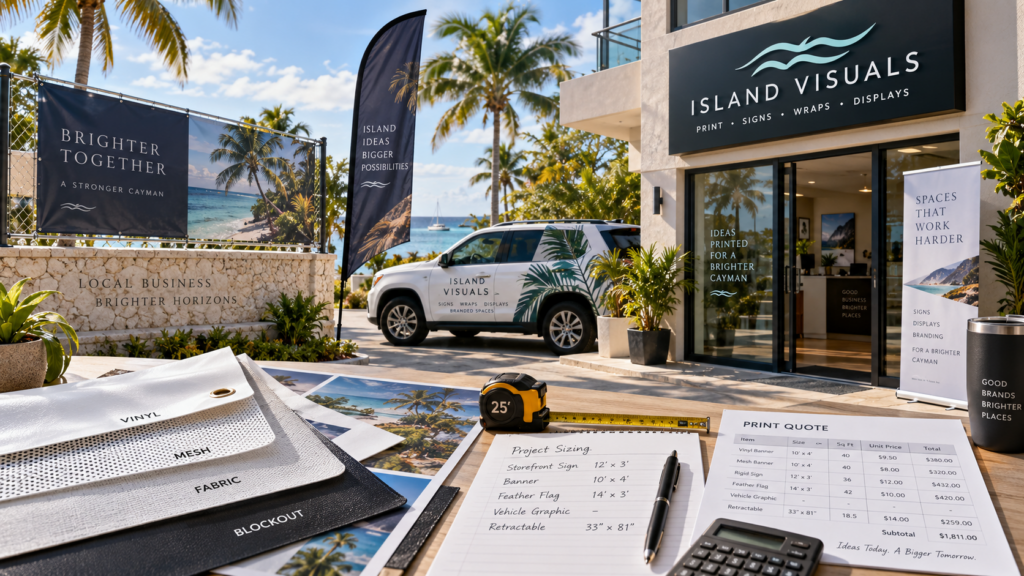
Large format printing covers everything too big for an office printer: the banner on the fence, the sign above the door, the graphics on the van, the backdrop behind your table at an expo. For most Cayman businesses it is also the most visible money they spend on marketing, because it is seen by people who never visit the website.
This guide explains what the category covers, how the material decisions are actually made, how pricing works, and what to have ready before you order.
What counts as large format
In practice, large format means anything printed on a roll or a rigid sheet at a size a commercial printer handles rather than a copier. That includes:
- Banners in vinyl, mesh, fabric and blockout material
- Rigid signs such as coroplast, PVC, aluminium composite and solid aluminium
- Vehicle wraps, magnets and window vinyl
- Feather and teardrop flags
- Trade show displays, tents and table coverings
- Wall murals, canvas and specialty transfers
The common thread is that the finished piece is viewed from a distance, usually outdoors or across a room. That single fact drives almost every decision that follows.
Start with the location, not the design
The most common mistake is designing first and choosing the material afterwards. Work in the other direction. Before anything else, answer three questions:
- Where will it live? Indoors, outdoors, on a wall, on a fence, on a vehicle, or carried between events.
- How long does it need to last? A weekend, a season, or years.
- What is working against it? In Cayman that usually means sun, salt air, rain and wind, in that order of frequency and any order of severity.
A sign that fails early is almost always a sign that was specified for a gentler environment than the one it ended up in.
Sun
Constant direct sun is the quiet killer. It fades colour and ages material faster than anything else on the island. Deep reds and bright blues show fading first, so a design that relies on a single flat colour will look tired before a design with more contrast and detail does.
Wind
A solid banner on an exposed fence acts like a sail. That is what mesh banner material is for: the perforations let air through, which dramatically reduces the load on the banner, the fixings and the fence. If a site is exposed, mesh is not a downgrade, it is the correct specification.
Salt and rain
Salt air is why rigid outdoor signage that needs to last is usually specified in aluminium or aluminium composite rather than a material that can corrode or delaminate. For anything semi-permanent outdoors, ask what the sign is expected to survive rather than what it costs today.
Size and readability
People judge a banner or sign from a distance and in motion. A useful rule of thumb: letter height of roughly one inch for every ten feet of viewing distance is the minimum for comfortable reading, and more is better when traffic is moving.
That has a design consequence most people resist: fewer words. A banner with one clear message, a way to make contact and enough empty space around them will outperform a banner carrying a paragraph every time. If a piece of information is only useful to somebody already standing still, it belongs on a card or the website, not on the banner.
How large format pricing works
Most large format items are priced by the square foot, which is why the Print Shop asks for your size before it shows a price. Enter the finished width and height and the price updates in Cayman Islands dollars. Items that are a fixed object rather than a printed area, such as a feather flag or a retractable stand, are priced per piece.
A few items are quoted rather than priced online. Channel letters are the clearest example: the cost depends on letter size, depth, lighting and mounting, so a generic online price would be misleading. Those items route to a quote instead of showing a number.
Getting artwork right
Large format is forgiving about resolution in one way and unforgiving in another. Because it is viewed from a distance, it does not need the same detail per inch as a business card. But a small logo enlarged to eight feet wide will still look soft, and no printer can add detail that was never in the file.
Send print-ready artwork built to the finished size where you can. If you are not sure the file will hold up, send it before you order and we will check it at the size you need and tell you plainly whether it will work. For a full walkthrough, read our guide to preparing artwork for printing, or send the file to us and we will check it.
Ordering, turnaround and delivery
Turnaround is 6 to 10 business days from artwork approval. Rush work may be available depending on the item and the schedule, so if your date is tight, ask before you order rather than after. Delivery is free across Grand Cayman, and we deliver rather than offer collection.
An account is required to complete a purchase, so your order and delivery details stay with you for reordering. Requesting a quote does not require an account. Orders up to CI$500 are paid in full before production; above CI$500 a 50 percent deposit is taken before production with the balance due before delivery. Payment is by bank transfer, cash, cheque, approved corporate credit or a verified government purchase order.
Where to start
If you know what you need, go straight to the Print Shop and configure it. If you are working out what suits the job, start with the service page for that format: banner printing, signs and large format, flags, trade show displays or wall graphics. Or send us the location, the size and a photo and we will tell you what we would specify.