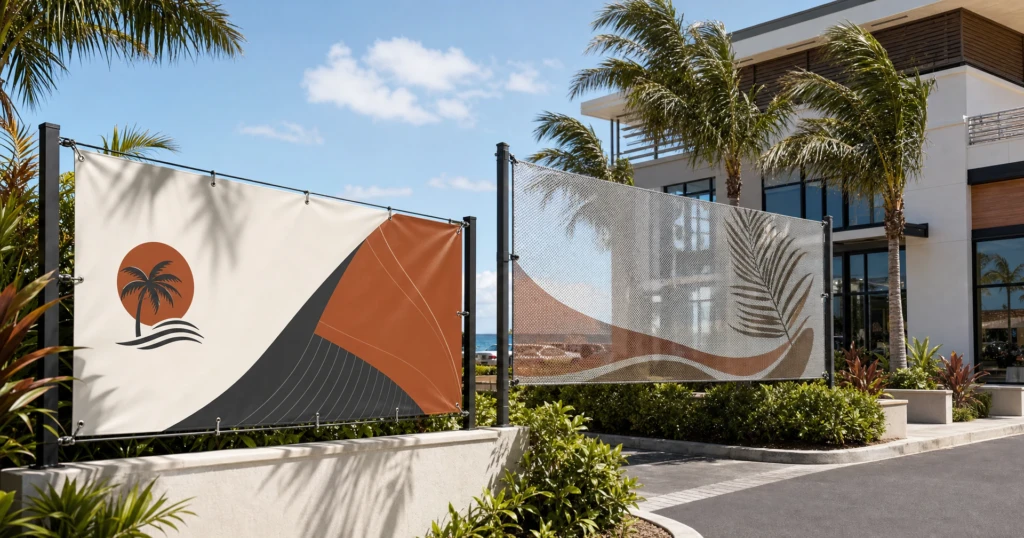
A banner cable-tied to a construction fence on West Bay Road, one hung from a hotel balcony above Seven Mile Beach and one behind a stage in an air-conditioned ballroom have little in common once they go up. Choosing banner material for Cayman weather comes down to the spot itself: the sun it gets, the wind that reaches it, how close it is to the sea, and how long the banner must stay.
Here is how the local climate treats a banner, which material suits which location, and how to plan placement, size and storm season before you order.
How Cayman’s climate works on a banner
Strong overhead sun and glare
Grand Cayman sits inside the tropics, so the sun is high and strong for most of the year, and long hours of direct light are hard on any printed surface. Where you have a choice of wall, avoid one that takes the full afternoon sun, or hang the banner beneath a canopy or overhang. Bold, high-contrast artwork also stays readable in glare, through sunglasses or a bright windscreen.
Salt air, humidity and storage
Near the coast, a fine film of salt settles on everything, and the humidity means a banner taken down damp stays damp. Before storing an outdoor banner, rinse it with fresh water, let it dry completely and roll it rather than folding it. Watch the fixings as well: metal hooks, wire and clips close to the water can corrode, and a weak fixing is often the first thing to fail.
Trade winds on open ground
The trade winds blow mostly from the east for much of the year, and they are strongest on open ground: waterfront terraces, upper balconies, rooftops and fences along open road. On a solid banner, every gust pulls at the ties and at whatever the banner is fixed to. Mesh is perforated, so much of that air passes straight through it instead.
Downpours in the wet season
The wet season generally runs from about May to October, and showers arrive fast and heavy. For exposed outdoor locations, a standard outdoor vinyl banner handles sun and rain well. Keep fabric banners indoors, and avoid the drip line of a roof edge, where runoff pours straight onto a banner.
The outdoor range: vinyl, blockout, mesh and pole banners
- The 13oz Vinyl Banner is the standard outdoor banner for shopfronts, fence lines, balcony railings and site hoarding, ordered single sided or double sided.
- The 18oz Blockout Vinyl Banner is the heavier vinyl. Its blockout layer stops light passing through, so each face reads cleanly even when the sun is behind the banner. Choose it where both faces are seen, such as between two posts or across a walkway. It also comes single or double sided.
- The Mesh Banner is the one for exposed sites, long fence runs and spots where the wind rarely drops. The perforations soften colour a little compared with solid vinyl, a fair trade where wind is the bigger risk. It has no double-sided option, so if a banner in a windy spot must be printed on both faces, talk to us first.
- The Pole Banner Set suits lamp posts and entrance poles. It comes in five set sizes from 18 by 36 inches up to 30 by 72 inches, as the banner only or with hardware, and with an optional windslit for breezier spots.
Indoors, under cover, or somewhere in between
Plenty of Cayman events happen in spaces that are neither fully indoors nor fully outdoors: a covered hotel terrace, a marquee on a lawn, a beachside reception. If wind, rain or sea air can reach the spot, treat it as outdoors.
Air-conditioned lobbies, conference rooms, shops and ballrooms open up lighter materials:
- Fabric Banner (9oz Wrinkle-Free) gives a soft textile look behind a stage or in a reception area.
- Blockout Fabric Banner (9.5oz) adds an opaque core to fabric, for indoor banners hung away from a wall.
- Super Smooth Indoor Banner is, as the name says, an indoor material, for lobbies, offices and shop interiors.
- Backlit Banner is made for graphics lit from behind, such as a lightbox panel.
Need a freestanding display for a conference or expo instead? Our comparison of retractable banners and tension fabric displays covers the stands and frames.
Planning around hurricane season
The Atlantic hurricane season runs from 1 June to 30 November and overlaps most of the wet season. A banner that goes up in summer needs a plan for coming down:
- Decide who takes banners down, and when. As soon as a tropical storm or hurricane watch is issued for the Cayman Islands, bring outdoor banners, pole banners and A-frames inside, before the wind builds.
- Fix banners so they come down quickly. Ties that can be undone or cut in minutes beat a mounting nobody can reach in a hurry.
- Keep your order details to hand. If a banner needs replacing after a storm, order the same product and configuration and tell us it is a reorder, so we can use the artwork already approved.
Short campaign or long stay?
Banners suit messages with an end date: a grand opening, a season of specials, a fundraiser, a development under construction. Because they roll up, they also suit businesses that set up and pack down every week, such as market stallholders.
If the message will not change and the sign is meant to stay, such as a business name at an entrance, a rigid sign is usually a better fit. Our guide to coroplast, PVC and aluminum composite signs explains the options.
For a long-running outdoor banner, such as a fence banner that stays up for a whole building project, match the material to the exposure and check the fixings after any spell of heavy weather.
Placement, size and finishing
Placement. Stand where your customers will be. A driver on West Bay Road sees a banner for a few seconds at an angle, while someone strolling the George Town waterfront reads it head on. Check sight lines for parked cars, other signs and palms, whose fronds can swing across a banner in the afternoon breeze.
Size. Measure the space where the banner will hang and order to that size. Banners are priced per square foot, so the price updates as you enter your width and height. Apart from the Pole Banner Set, each banner material above can be ordered up to 10 feet on the short side and 150 feet on the long side, in either orientation.
Finishing. The outdoor vinyl banners come finished, ready to hang. Let us know what yours is going onto, whether a chain-link fence, a balcony railing, scaffold poles or two posts on a lawn, and we can advise before it is printed. Decide early on one printed side or two, because it limits which materials you can choose, and for double sided, supply the front and back as separate PDF files.
Artwork. The banner rule is “No crop marks. No bleed.” Upload your artwork as a single-page PDF, and keep text, logos and any critical design elements away from the outer edge.
When to ask Creative Exposure for guidance
Ask us before you order if:
- the site is on the waterfront, a rooftop or a high balcony
- both sides of the banner will be seen, especially in a windy spot
- you are not sure whether a covered terrace or tent counts as indoors
- the banner is very long, or you are between sizes
- the banner has to be up by a fixed date, or stay up through hurricane season
If you are unsure how it will sit, send us the measurements and a photo of the location and we will advise.
Order a banner that suits the spot
When you know what you need, browse the full banner range in the Print Shop, or see how the materials compare on our banner printing page. For a recommendation first, request a quote from Creative Exposure, email sales@creative.ky or message us on WhatsApp, and tell us the date you need the banner by.
Turnaround is 6 to 10 business days from artwork approval, so the sooner your files are approved, the safer an opening or fundraiser date becomes. Rush work may be available. Please WhatsApp or email us to confirm availability. We deliver across Grand Cayman.